Desk Mat, Writing Board, or Bare Table: What Changes Under the Page
The surface beneath your notebook can change how steady the page feels, how easily you can move your setup and how much room remains for everything else.
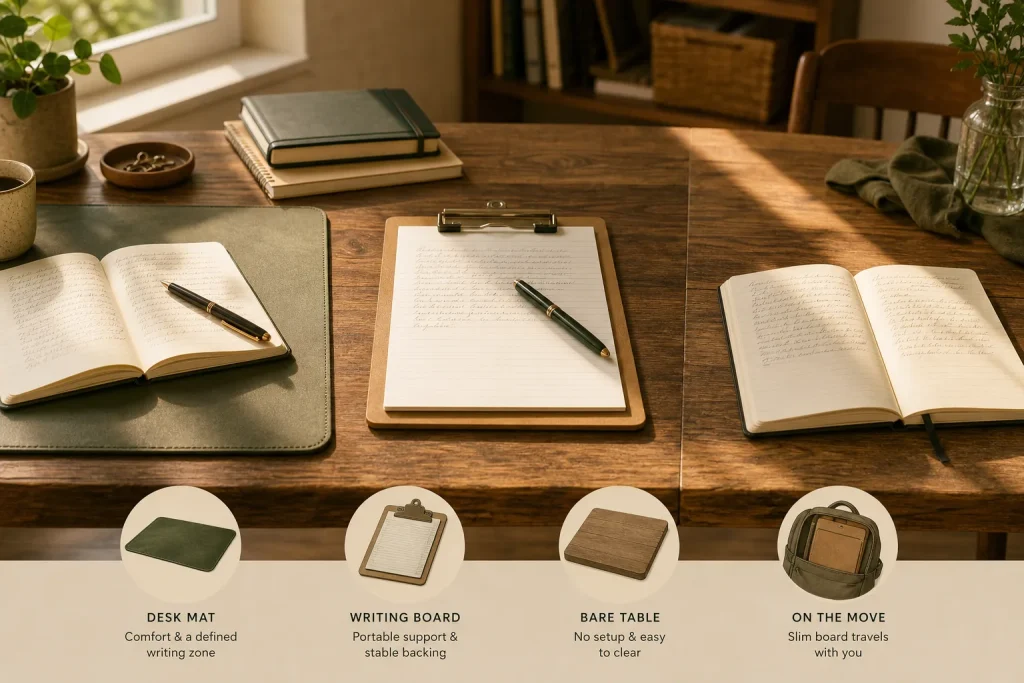
Does your notebook wobble, slide about or feel uncomfortably hard beneath your hand? The fix may be under the page rather than in the pen. A desk mat, a firm writing board and a bare table each change the feel of writing, but they also make different demands on space, storage and portability. The right choice depends on where you write and what else has to fit on the desk.
For a fixed desk
If you write at the same desk most days and want a softer landing for your wrist, a desk mat is usually the natural fit. It stays in place, covers a useful patch of the tabletop and gives a notebook or loose sheet a consistent surface. A leather or synthetic-leather mat feels smooth; a felt mat adds a softer, slightly grippier layer.
That comfort comes with a space trade-off. A large mat claims room even when you are not writing, and a keyboard, mouse or cup may share its territory. If you use a laptop at one end of the desk and a journal at the other, a smaller mat can define a writing zone without turning the whole worktop into one continuous surface.
Choose a mat with a finish that suits your habits. A slick surface can let paper creep as your hand moves; a textured one may hold it more firmly, though some textures feel uneven beneath thin paper. If you often use loose sheets, check whether the mat lies flat and whether its edges catch your sleeve.
For a hard tabletop
A writing board suits you if the table itself feels too hard, too uneven or too marked for comfortable writing. Clipboards are the familiar option: the clip keeps a sheet or slim pad in place, and the rigid backing gives your hand stable support. A smooth board without a clip can work well beneath a notebook, especially if you want to lift the whole writing setup and move it elsewhere.
Boards are easy to store because they can lean beside a desk or slip into a bag. They also take up little room while you are writing: only the board’s footprint is occupied. The compromise is that they do not soften the contact between your wrist and the surface. A rigid board can improve steadiness without making the writing area feel cushioned.
Look for a board with a clean, flat face and edges that will not snag paper. If you use a clipboard, make sure the clip does not get in the way of your hand or the top of your notebook. A bulky clip can be awkward with a bound journal, while a plain board may need a separate clip or a little care to keep loose sheets aligned.
For shared space
If your desk doubles as a dining table, craft surface or family work area, bare table is often the most sensible choice. It needs no setup and disappears as soon as you close the notebook. A clear, smooth tabletop can support writing perfectly well, and keeping the surface bare makes it easy to switch activities.
The main question is whether the table is actually comfortable and steady. A rough grain, a deep seam between leaves or a tablecloth with a soft weave can make the page feel lumpy. If the table is already level and your notebook has a firm back cover, adding another layer may not improve much.
For a quick check, write a few lines on the table, then repeat with a board underneath. Notice whether the page shifts, whether your hand feels more supported and whether the board makes the notebook awkwardly high. This is a simple comparison you can make with the materials already at home; no special purchase is needed.
For writing on the move
If you write in a café, on a train or in a waiting room, portability matters more than covering a whole desk. A slim writing board is usually the easiest companion: it protects the page from an uneven surface and can travel with a notebook or a small stack of paper. A clipboard is handy for loose sheets, though its clip adds bulk.
A desk mat is less convenient to carry. It can be rolled or folded only if its material allows, and it may collect dust or crease in a bag. A small mat can still make sense if you regularly work at temporary desks and value a familiar, grippy surface, but it is not the most compact option.
Bare table is the lightest setup because there is nothing extra to pack. It is also the least predictable: a café table may have a raised edge, a train tray may flex, and a public table may be damp or marked. If you choose to write directly on one, keep a notebook with a firm cover as a buffer for the page.
For a shared notebook
If several people use the same desk, consider what happens when writing stops. A mat can quietly reserve a section of the worktop, which is useful if that area belongs to your journal routine but frustrating if someone else needs the space. A board can be lifted and put away in a moment. Bare table asks for no storage at all, but offers no protection from objects placed on top of an open notebook.
Say you share a small kitchen table and want to write while someone else prepares dinner. A thin board under your notebook would give the page a stable base and could be moved to a shelf when you finish. A full-size mat would make the writing spot more comfortable, but it would occupy table space after the notebook was put away. If comfort matters less than clearing the table quickly, bare wood and a firm-backed notebook may be enough.
What to skip
It is not worth buying a large mat simply because it looks tidy in a photograph. First decide where the notebook will sit, what needs to remain on the desk and whether the tabletop already feels comfortable. Likewise, a board with extra pockets or a fancy clip is unnecessary if you only need a flat backing.
Choose a desk mat for a settled writing place and a softer, defined area. Choose a writing board for portable support, especially with loose pages or an uneven table. Choose the bare table when space, easy clearing and a firm notebook cover matter most. If none feels quite right, start with a board you already own or a clean sheet of firm card; the useful question is whether the page becomes steadier without making the rest of your desk harder to use.