Smooth Paper, Drying Time, and the Pen You Already Own
A slick page can make a pen glide beautifully, but the right paper also needs to let its ink settle at a pace that suits your hand. Here’s how to judge the pairing before choosing a notebook.
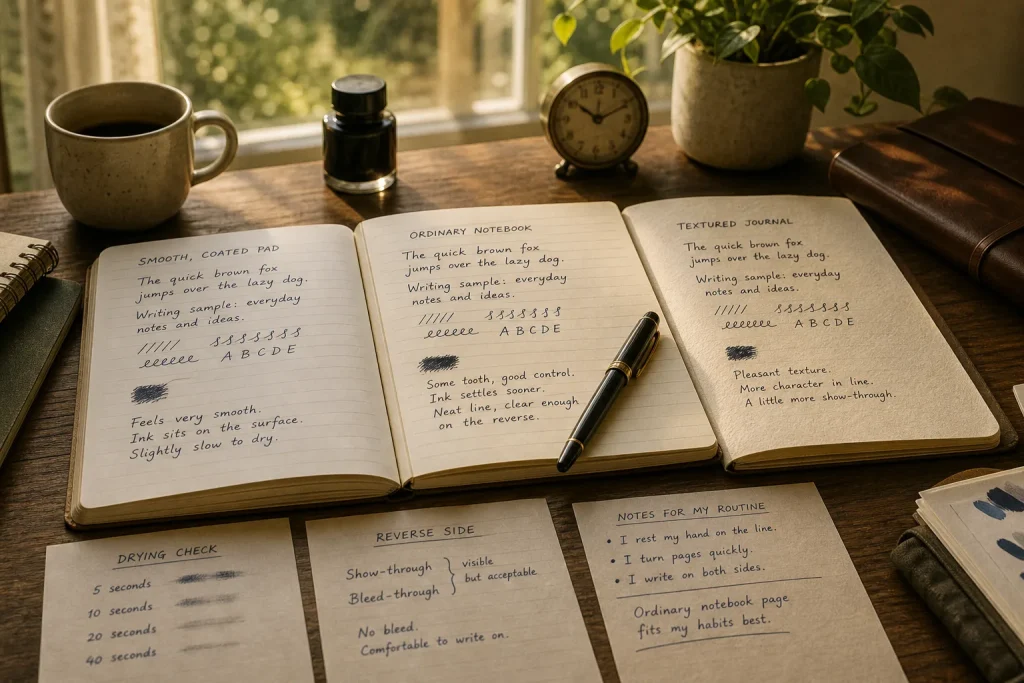
Does your pen feel wonderful on one page and smear across another? Before replacing it, look at the paper. A coated, glossy sheet can make the nib glide, yet leave wet ink sitting on the surface. A more absorbent page may dry sooner but feel draggy or let ink feather into the fibres. The best match is not necessarily the smoothest sheet; it is the one that suits your ink, your handwriting and the way you use the page.
You can make that choice with the pen you already own. Work through a small comparison in order, using the same pen and a few representative papers. You do not need a special testing kit: a notebook, a scrap sheet, a timer if you like, and a clean piece of paper for checking transfer are enough.
Start with your pen
Use the pen you reach for most, rather than a favourite that rarely leaves its case. Note its type and ink: a gel pen, a fountain pen with a water-based ink, a felt-tip, and a ballpoint can behave quite differently. Even within one type, a broad line generally puts down more ink than a fine one, so test with your usual nib or tip.
Make sure the pen is writing normally. If its tip is clogged, its cartridge is nearly empty or its ink is unusually wet, the paper comparison will be hard to interpret. You need not clean or tune the pen unless it is already misbehaving; simply begin with the same working pen throughout.
Think about your own writing habits, too. Do you rest your hand on the line you have just written? Do you turn pages quickly, write on both sides, or use a ruler over headings? Those ordinary details make drying time more than a technical curiosity. A page that is pleasant for slow journalling might be awkward for hurried notes.
Choose useful papers
Gather a few papers with noticeably different surfaces. A smooth, coated writing pad, an ordinary ruled notebook and a slightly textured journal page make a useful starting set. If you are comparing notebooks you might actually buy, use spare pages or samples from the same products rather than relying on a label such as “premium” or “for fountain pens”. Such descriptions can help narrow the choice, but they do not tell you how the page will feel with your particular pen.
Keep the papers flat and write in a similar place on each. If one sheet is very thin, put a scrap of plain paper beneath it, as you would when writing in the notebook. That prevents the surface below from changing the feel and gives you a better idea of whether ink shows through or marks the next page.
It is not worth buying a large stack of specialist paper just to answer this question. A few samples from a stationery shop, a friend’s notebook or a pad you already have can reveal plenty. The point is to compare practical options, not to build an elaborate laboratory on your desk.
Write the same lines
On each paper, write the same short passage at your ordinary pace. Include connected letters, a few curves, a capital heading and a line where your hand naturally crosses the writing. A short sentence is more useful than a page of repeated loops because it resembles the marks you make in real notes.
Notice the feel as you write. Does the tip glide so freely that your letters become loose? Does the surface catch at turns? Is there enough resistance to help you control a small letter? Smoothness is a preference, not a score: some writers like a glassy glide, while others find a little texture reassuring.
Then look at the line itself. Ink may spread sideways into fuzzy edges, show through to the reverse, or appear vivid and tidy. A fountain pen’s shading may look different on two surfaces; a gel pen may leave a raised, shiny line on paper that absorbs it slowly. These are visible interactions between this ink and this sheet, not fixed qualities of either one in every setting.
Check the drying
After writing, wait briefly before touching the line, then try a light pass over a separate marked area with a clean fingertip or scrap paper. Repeat after a longer pause. You are looking for the point at which the ink stops transferring under the way you handle your pages, rather than chasing a universal drying time.
Take care not to smear the whole sample as you check it. Leave one part of the writing untouched, and use a different short line for each pass. If you keep a notebook, close it as you normally would only after the ink has settled enough for your routine. A page that dries in open air but transfers when shut may still be an inconvenient choice for you.
Imagine you use a broad gel pen to write morning notes and turn the page soon afterwards. On a coated pad, the line feels slick but transfers when you rest your hand on it. On an ordinary notebook page, it feels less slippery and settles sooner. If the second page remains clear enough for your handwriting, it may be the better match despite being less smooth. If you usually leave the notebook open, the coated surface could still suit you.
Read the reverse
Turn each sheet over and inspect it in ordinary light. There is a difference between ink visible through paper and ink that has actually bled to the other side. Both can affect how pleasant a notebook is, but they have different consequences: show-through may bother you visually, while bleed-through can interfere with writing on the reverse.
Try a few lines on the back as well. A notebook that is lovely on one side but uncomfortable on the other may not be ideal for pages you want to use fully. For a journal where you write on one side only, that trade-off might matter less. Decide based on how you actually use the notebook, rather than rejecting a sheet for a flaw that has no effect on your routine.
Choose for your routine
Compare the samples by practical priorities: comfort under the pen, crispness of the line, transfer while you write, and usability on the reverse. If one paper wins on feel but loses on drying, consider whether you can change your habit slightly—perhaps leaving the page open for a moment. If that would irritate you every day, choose the less glamorous sheet that behaves better with your pen.
There is no need for a formal scorecard, but a few words beside each sample can help: “glides, slow to settle”, “slight tooth, neat reverse” or “smooth, fuzzy edges”. Keep the notes tied to the pen you used. If you later switch from a fine ballpoint to a wet fountain pen, the same paper may feel and perform differently.
When you next buy a notebook, try to handle a sample and write with your own pen if the shop allows it. If not, look for a return or sample policy and treat product descriptions as clues, not promises. Paper choice is personal, but the decision need not be mysterious: match the surface to the ink and the pace of your hand, and let the page earn its place on your desk.