The Journal Format That Survives a Missed Week
Dated, undated and open-page journals each handle blank stretches differently. Choose the format that welcomes your real rhythm rather than turning a pause into a failure.
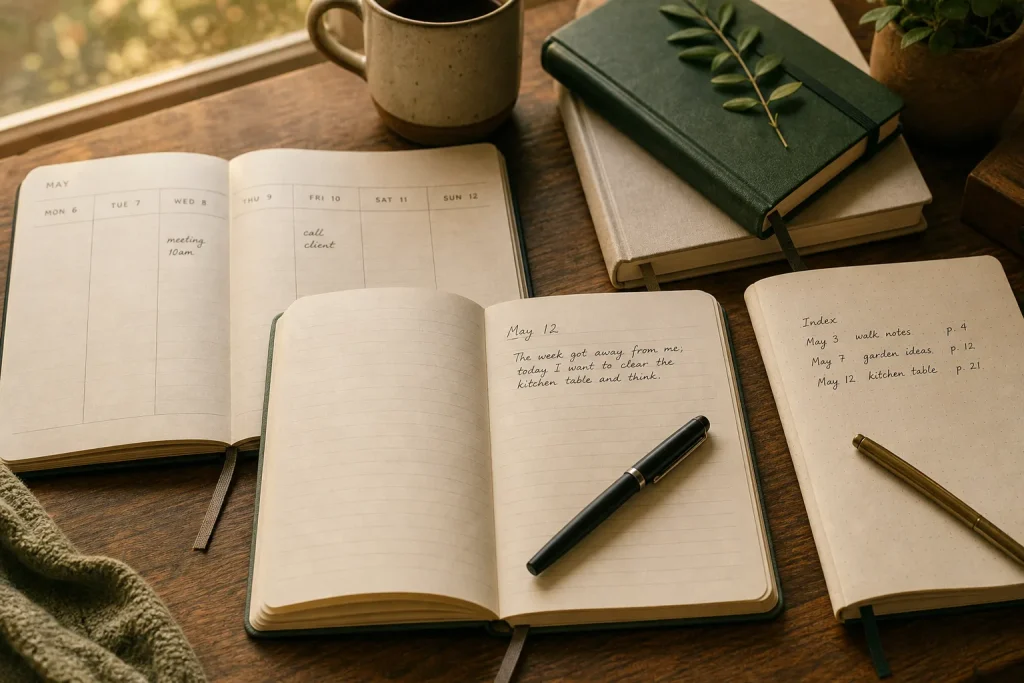
You open your journal on Sunday evening and find the last entry is from the previous week. Do you turn to today’s date, write on the next blank page, or feel an odd tug to explain the gap? The format you chose can make that moment feel either ordinary or loaded with meaning.
Dated, undated and open-page journals all offer structure, but they place it in different spots: on the calendar, in the layout or almost nowhere at all. The right one is not the format that keeps you writing every day. It is the one that makes returning feel manageable after life has interrupted your routine.
Dates on every page
A dated journal assigns a space to each day, often with the date already printed. Some have a page per day; others give a week a spread, with a box or column for each date. This can make the book easy to scan. If you want to see what happened on a particular Tuesday, the page is waiting where you expect it.
The trade-off is visible blank space. Miss a week in a daily journal and a run of empty pages can look like a record of absence, even if you never meant the book to keep score. Weekly layouts soften that effect because there may be room to write only on the days that matter, but the dates still announce each unfilled space.
Dated pages suit people who use a journal as a calendar companion, keep recurring logs, or like opening to a known day without adding a heading. They can also help if your entries depend on sequence: notes about a project, reflections during a busy season, or brief records you may want to trace through time.
They are less forgiving if you have an irregular schedule or tend to write in bursts. The issue is not that a dated journal is inherently strict. It is that its structure keeps time in view, and some people find that reassuring while others experience it as a row of unfinished appointments.
Undated daily pages
An undated daily journal gives you a day-sized space without assigning it to a particular date. You add the date yourself when you write, then leave the next page untouched until you return. That small difference can remove the sense that you are late: the book has no pre-labelled Wednesday waiting for you to fill it.
This format is a good fit if you want a familiar amount of room each time, but your writing rhythm changes from week to week. It keeps a gentle routine available without requiring daily attendance. The page can hold a paragraph, a list or a longer entry, and you decide when the next one begins.
There is a little upkeep. You need to write the date, and if you leave out a page heading, you may later need to infer when an entry was made. A simple habit solves most of this: put the date at the top, even if the rest of the page is only a sentence. If exact dates are not central to your journaling, a month and day may be enough for your own reference.
Some undated journals still carry a prescribed prompt or a fixed daily layout. That can be helpful if a blank page feels too open, but it does not make the book fully flexible. Before choosing one, look at a sample spread and ask whether the printed questions feel inviting or like another set of tasks to complete.
Open pages, loose rhythm
An open-page journal gives you a blank or lightly ruled page without a daily slot. You decide whether an entry takes half a page, a spread or several pages, and you can add dates, headings, sketches or lists as needed. A plain notebook, a dot-grid book and a journal with numbered but undated pages can all work this way.
This format makes gaps almost invisible. After a pause, you simply use the next page. There is no empty Tuesday to account for, and you do not have to catch up before writing about what is happening now. That freedom can be a relief if journaling is something you reach for when you have a thought rather than at a set hour.
Open pages ask you to make more decisions, though. You choose where an entry starts, how much space to leave and how to find older notes. If you enjoy shaping a page, those choices can be part of the pleasure. If you mainly want to sit down and write, setting up a layout may become friction.
A modest indexing habit can help without turning the notebook into a project. Number pages as you use them, then keep a short list of useful entries inside the cover or on the first page. You might note “April — garden plans” or “letter draft — page 18”. Skip the index if you rarely need to retrieve entries; elaborate colour coding and carefully ruled trackers are not worth the effort unless you genuinely enjoy maintaining them.
What a gap means
A gap is a feature of your life, not a verdict on your discipline. Still, the page can influence how you read it. Dated layouts make elapsed time clear. Undated daily pages preserve a steady unit of writing without displaying missing days. Open pages treat entries as separate occasions rather than a continuous chain.
That distinction matters if you tend to restart after a break. A dated planner-style journal may encourage you to backfill, especially if its pages look like a calendar. An undated book makes it easier to resume at the next unused page. An open notebook makes it easy to begin with whatever is on your mind, but may offer less of a prompt to return.
Think, too, about what you want the journal to remember. If you want a chronological account, dates help. If you want a place to reflect when the need arises, a blank page may be enough. If both sound useful, a hybrid can work: choose an undated weekly spread, or use an open notebook and write the date at the start of each entry.
A gentle return
Say you have an undated daily journal and leave it untouched during a demanding week. When you reopen it, you write the current date at the top of the next page, then add: “The week got away from me; today I want to clear the kitchen table and think.” The expected result is simple and observable: your next entry begins where you are, with no need to recreate the missing days. If you later want a record of that week, you can add a brief note, but the journal does not require one.
The same approach can work in a dated journal, though you may choose to turn directly to today’s page and leave earlier ones blank. In an open notebook, the equivalent is to start a fresh page and mark the date. The useful move is not a perfect explanation for the pause; it is making the next page available.
If you like continuity, a short bridge note can restore context: “Last entry was about the move; this week I’m sorting the books.” Keep it factual and brief. You do not owe the journal an apology, and a missed stretch does not need a dramatic reset or a new notebook.
Choose by your rhythm
Pick a dated journal if you want a clear calendar record, rely on day-by-day structure or enjoy seeing entries arranged against the week. Before buying, check whether it gives you a full page per day or a shared weekly spread; the amount of space changes how demanding empty dates may feel.
Choose an undated daily journal if you like a consistent place to write but do not want the book to mark days you missed. It is a useful middle ground for someone who wants a familiar page without a daily obligation. Check that you like adding dates and that the prompts, if any, do not make each entry feel like homework.
Choose an open-page journal if your entries vary in length, you write in bursts, or you want room for notes and sketches alongside reflection. Look at the ruling and binding as well as the layout: a lined page may help you begin, while a dot grid can accommodate lists and small diagrams without prescribing a format. Consider whether you will enjoy keeping track of older entries, or whether an occasional heading is all you need.
If you are unsure, borrow the format rather than committing to a whole book. For a few weeks, use a notebook you already own and try one rule: date every entry, use one page per writing session, or divide each spread into a loose weekly area. Notice which setup lets you return without first negotiating with the blank page. You are not evaluating your consistency; you are learning which kind of structure feels kind.
The best journal format is the one that still makes sense when your routine changes. A printed date can be a useful anchor, an undated page can offer a soft landing, and an open notebook can leave the door wide open. Choose the amount of structure you want on an ordinary day, then let the next entry begin whenever you are ready.